Flames of Faith: Orthodox Christians Gather for Ancient Holy Fire Ritual
Amid singing, ringing bells, and centuries of tradition, thousands witness the solemn descent of the Holy Fire inside Jerusalem’s Church of the Holy Sepulchre.
JERUSALEM — In the heart of the Old City, inside the labyrinthine stone corridors of Christianity’s most sacred shrine, a quiet sea of anticipation gave way to a roar of jubilation. Thousands of Orthodox Christian pilgrims from around the world stood shoulder-to-shoulder on Holy Saturday to witness the emergence of the “Holy Fire,” an ancient, mystical rite that heralds the resurrection of Jesus Christ.
The ceremony takes place within the Church of the Holy Sepulchre—the cavernous basilica built over the traditional sites of Christ’s crucifixion, burial, and resurrection. For more than a millennium, the Holy Fire ceremony has served as the spiritual climax of the Eastern Christian calendar, drawing faithful travelers across continents to a crowded rotunda thick with the scent of beeswax and frankincense.
The Ancient Protocol
Steeped in rigorous tradition, the ceremony follows a centuries-old script meant to safeguard the authenticity of the event:
- The Inspection and Sealing: Hours before the ceremony, the Tomb of Christ (the Aedicula) is meticulously inspected to ensure no hidden matches, lighters, or embers are present. The heavy doors are then sealed shut with beeswax mixed with honey, stamped with official wax seals.
- The Procession: Accompanied by traditional chants and the resonant rhythm of drums, the Greek Orthodox Patriarch of Jerusalem leads a solemn procession circling the Aedicula three times.
- The Solitary Prayer: Stripped of his ornate liturgical vestments to demonstrate he conceals no fire-starting implements, the Patriarch enters the dark inner chamber of the Tomb alone, bearing bundles of 33 unlit white tapers—symbolizing each year of Christ’s earthly life.
“In that chamber, there is only prayer and profound silence before the light appears. It is a moment where heaven meets earth, renewing our hope across the world.”
A Cascade of Light
Inside the sealed chamber, the Patriarch kneels in deep prayer. According to tradition, a celestial light descends upon the marble slab where Christ’s body was laid, igniting an oil lamp.
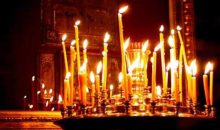
Within moments, the Patriarch emerges from the chamber, holding burning torches aloft. The reaction inside the basilica is instant and electric: church bells toll frantically, joyful cheers and ululations echo through the vaulted limestone ceilings, and the dim, cavernous church ignites into a dazzling blaze of gold.
Like a wave passing through water, the flame is passed hand-to-hand, candle-to-candle across the thousands assembled in the basilica. Within seconds, a sea of fire illuminates tears, smiles, and raised hands. Many pilgrims wash their faces and beards in the flames, sustained by the ancient belief that in its initial minutes, the Holy Fire radiates warmth without causing burns.
Carried Beyond Borders
The journey of the Holy Fire does not end beneath the stone domes of Jerusalem. As soon as the flame emerges, lanterns carrying the sacred fire are dispatched under diplomatic escort to Ben Gurion Airport.
Special charter flights transport the flame to Orthodox capitals worldwide—including Athens, Sofia, Bucharest, Tbilisi, and Kyiv—where heads of state and high-ranking clergy receive the fire on the tarmac with full honors. From there, it is rushed to parish churches in time for midnight Paschal liturgies, uniting millions across borders in a singular light.
A Symbol of Resilience and Renewal
While the ceremony is not without logistical and security complexities—often marked by strict crowd caps and heavy coordination among Israeli authorities, local police, and the various Christian denominations that share custody of the church—it remains an indelible symbol of endurance.
For the pilgrims crammed into the tight galleries and courtyards, the Holy Fire is more than an impressive display; it is a tangible reassurance of light overcoming darkness, life conquering death, and an ancient heritage that refuses to be extinguished by the passage of time.